Labbaik International is a complete service from travel to Saudi Arabia and back home which count us in best Hajj travel agencies in Pakistan & highly recommended travel agency for overseas Pakistanis.
Upon your arrival at your hotel or accommodation in Azizia, Makkah, here is a straightforward guide for your first Umrah experience with Labbaik International, outlining the steps you need to follow:
This makes your first Umrah experience smoother and more fulfilling.
The minimum number of days required to complete the Hajj pilgrimage is five days, spanning from the 8th to the 12th of Dhul-Hijjah. These are the essential days for performing the obligatory rites of Hajj. Here’s a breakdown of the key rituals on these days:
Day 1: 8th of Dhul-Hijjah (Yawm al-Tarwiyah)
Day 2: 9th of Dhul-Hijjah (Day of Arafah)
Day 3: 10th of Dhul-Hijjah (Eid al-Adha)
Day 4: 11th of Dhul-Hijjah (First Day of Tashreeq)
Day 5: 12th of Dhul-Hijjah (Second Day of Tashreeq)
Optional: 13th of Dhul-Hijjah (Third Day of Tashreeq)
Summary of Minimum Days
By adhering to this schedule, pilgrims fulfill all the necessary requirements of Hajj.
There are three forms of Hajj, each with its own unique characteristics and sequence of rituals. These are:
Summary of Differences:
Type | Umrah Included? | Ihram | Sacrifice (Hadiy)? |
Tamattu’ | Yes (separate) | Two Ihrams | Yes |
Qiran | Yes (combined) | One Ihram | Yes |
Ifrad | No | One Ihram | No |
Each type of Hajj has its own rulings, but all are valid forms of fulfilling this fifth pillar of Islam. The choice depends on the individual’s circumstances, intention, and location.
Hajj Tamattu is one of the three forms of performing Hajj (pilgrimage) in Islam, distinguished by its combination of both Umrah (the lesser pilgrimage) and Hajj (the major pilgrimage) in a single journey during the Hajj season. It is the most commonly performed type of Hajj among pilgrims, especially those coming from outside Saudi Arabia.
Here’s an overview of Hajj Tamattu:
Key Features:
Steps of Hajj Tamattu:
Why Is It Called “Tamattu”?
The term “Tamattu” (تَمَتُّع) means “enjoyment” or “relief” because the pilgrim enjoys a break between Umrah and Hajj by exiting Ihram and resuming normal life before re-entering Ihram for Hajj.
Sacrifice (Hadiy):
Pilgrims performing Hajj Tamattu are required to offer an animal sacrifice (or arrange for it) as a token of gratitude for being able to combine both Umrah and Hajj in one season. If unable to afford the sacrifice, they must fast for 10 days—three during Hajj and seven after returning home.
Significance:
Hajj Tamattu allows pilgrims to perform both major acts of worship—Umrah and Hajj—in one trip, making it practical and fulfilling for those traveling long distances.
The most important ritual in Hajj is the Standing at Arafat (also known as Wuquf at Arafah, الوقوف بعرفة). It is considered the pinnacle of the pilgrimage and a fundamental requirement for the validity of Hajj.
Why is it the most important ritual?
“Hajj is Arafah” (Sunan al-Tirmidhi, 889; Sahih al-Bukhari, 1654).
This highlights the centrality of this act in completing the pilgrimage.
“There is no day on which Allah frees more people from the Fire than the Day of Arafah.” (Sahih Muslim, 1348).
What happens during Wuquf at Arafah?
Standing at Arafat is the heart of the Hajj journey, symbolizing the pilgrim’s plea for forgiveness, renewal, and connection with Allah.
Mina is a significant site in the Hajj pilgrimage, located about 5 kilometers east of the Holy Mosque (Masjid al-Haram) in Makkah. It is also known as the “City of Tents” because of the thousands of air-conditioned tents set up to accommodate pilgrims during the Hajj season.
Why is Mina Important?
Mina holds a central role in the rituals of Hajj and is visited for specific acts of worship that are integral to the pilgrimage. Here are the key reasons for its importance:
Why is it Necessary to Stay in Mina?
Summary of Activities in Mina:
By staying in Mina and performing the associated rituals, pilgrims fulfil essential aspects of Hajj while internalizing its spiritual and historical significance.
The plain of Arafat (also called Mount Arafat or Jabal al-Rahmah, جبل الرحمة) is located about 20 kilometers (12 miles) east of Makkah, Saudi Arabia. It is a wide, open desert plain with a central granite hill, Jabal al-Rahmah, believed to be the site where the Prophet Muhammad (peace be upon him) delivered his Farewell Sermon.
Why Do We Go to Arafat?
Visiting Arafat is the most critical ritual of Hajj. It represents the spiritual climax of the pilgrimage and carries profound religious significance:
“Hajj is Arafah” (Sunan al-Tirmidhi; Sahih al-Bukhari, 1654).
This means the entire pilgrimage hinges on standing at Arafat; missing it invalidates the Hajj.
What Do We Do at Arafat During Hajj?
“The best dua is the dua on the Day of Arafah.” (Muwatta Malik)
Significance of Arafat:
“There is no day on which Allah frees more people from the Fire than the Day of Arafah.” (Sahih Muslim, 1348).
Summary:
At Arafat, pilgrims experience the spiritual essence of Hajj, standing before Allah in humility and repentance, seeking His mercy and renewal. It is a day of immense significance and reward, binding pilgrims together in their devotion to Allah.
Muzdalifah is a sacred site located between Mount Arafat and Mina, approximately 9 kilometers from Masjid al-Haram in Makkah, Saudi Arabia. It lies along the route that pilgrims take as part of the Hajj rituals and covers an area designated specifically for this purpose.
Why Is Going to Muzdalifah Important?
Visiting Muzdalifah is an essential part of the Hajj pilgrimage, as it fulfils specific obligations (wajibat) of the pilgrimage. Here’s why it is significant:
Key Rulings:
Symbolism of Muzdalifah:
Visiting Muzdalifah fulfils a vital part of the Hajj journey, linking the spiritual high of Arafat with the actions of stoning at Mina and the broader message of devotion, humility, and community in Islam.
During Hajj, pilgrims perform the ritual of Rami al-Jamarat (stoning the Jamarat) in Mina. The total number of stones you throw depends on the number of days you stay in Mina for the stoning ritual:
Total Number of Stones:
Why Do I Throw Stones at Jamarat?
The stoning of the Jamarat is a symbolic act with deep religious and spiritual meaning:
For How Many Days Do I Perform Rami al-Jamarat?
The stoning ritual is performed over three to four days:
How to Perform the Stoning (Rami):
“Bismillah, Allahu Akbar” (In the name of Allah, Allah is the Greatest) with each throw.
Key Lessons from the Ritual:
By performing the stoning ritual, pilgrims not only follow the footsteps of Prophet Ibrahim but also strengthen their faith and renew their commitment to a righteous path.
None of the Hajj packages offered by Labbaik International includes Qurbani. It’s important to understand that there are three types of Qurbani.
Labbaik International offers Hajj Qurbani services for an additional fee (Fee is Only confirmed by Saudi authorities nearer the time. In 2024 Hajj, Each Qurbani was 650 SAR), available upon request and payment from the Hujjaj. Qurbani is an essential part of the Hajj rituals and is compulsory for those performing Hajj-e-Qiran and Hajj-e-Tamattu, but it is not required for Hajj Ifrat.
The sequence of rituals following Muzdalifah begins with the Rami on the first day, followed by Qurbani, a haircut/head shave, removal of the Ihram, and concludes with Tawaf-e-Vida. The Qurbani is performed on the 10th of Zil Hajj. Hujjaj who have opted for Labbaik International’s Qurbani service are advised to complete the Rami as soon as possible and request your Qurbani on the phone number provided by giving your name and reference number on the provided Qurbani list. Once your Qurbani is performed, you will be notified by phone call or text message and now you can cut your hair/shave head.
Pilgrims have the option to make their own independent arrangements for Qurbani through any reputable source.
If the Rami on the first day is completed late in the day, the Qurbani will be rescheduled for the 11th of Zil Hajj.
Additionally, Labbaik International offers assistance with Dum Qurbani, which serves as a precautionary measure for any violations made during the state of Ihram. Requests and payments for Dum Qurbani can be made in person to Labbaik International on the ground, as it must be performed within the Makkah Regional Limits.
The last type, Eid Qurbani, is something that Hujjaj can arrange in their home countries, and Labbaik International does not entertain or assist with it.
The Hajj ministry has officially let women to perform the pilgrimage without a male relative or Mehram. This is if they go in a group.
Duas to Recite During Tawaf (Circumambulation of the Kaaba)
During Tawaf, there are no specific obligatory supplications, so pilgrims can recite any duas (prayers), dhikr (remembrance of Allah), or even personal supplications in any language. However, the following duas and dhikr are commonly recited during Tawaf:
بِسْمِ اللَّهِ وَاللَّهُ أَكْبَرُ
“Bismillah, Allahu Akbar”
(In the name of Allah, Allah is the Greatest)
If possible, touch or kiss the Black Stone. If not, point towards it and proceed.
Between the Yemeni Corner (Rukn al-Yamani) and the Black Stone, it is Sunnah to recite:
رَبَّنَا آتِنَا فِي الدُّنْيَا حَسَنَةً وَفِي الْآخِرَةِ حَسَنَةً وَقِنَا عَذَابَ النَّارِ
“Rabbana atina fid-dunya hasanatan wa fil-akhirati hasanatan wa qina ‘adhab an-nar.”
(Our Lord, grant us goodness in this world and goodness in the Hereafter, and protect us from the punishment of the Fire.)
(Quran 2:201)
After completing the seven circuits, proceed to Maqam Ibrahim (Station of Ibrahim) and recite:
وَاتَّخِذُوا مِن مَّقَامِ إِبْرَاهِيمَ مُصَلًّى
“Wattakhidhu min Maqami Ibrahima musalla.”
(And take the station of Ibrahim as a place of prayer.)
(Quran 2:125)
Pray two raka’at of Tawaf near Maqam Ibrahim or anywhere behind it or anywhere in the Haram.
Tips for Supplications During Tawaf
The beauty of Tawaf lies in its personal and spiritual connection to Allah, so make the most of this sacred moment to pour out your heart in devotion and prayer.
Safa and Marwa are two small hills located inside the Masjid al-Haram in Makkah, Saudi Arabia. They hold immense significance in Islamic history and are integral to the Hajj and Umrah pilgrimages.
The ritual performed at Safa and Marwa is called Sa’i, which commemorates the actions of Hajar (Hagar), the wife of Prophet Ibrahim (Abraham, peace be upon him). In her search for water for her infant son Ismail (Ishmael), Hajar ran back and forth between these two hills, demonstrating her trust in Allah. Her perseverance was rewarded when the spring of Zamzam miraculously gushed forth to provide water.
What Do I Do at Safa and Marwa?
During Sa’i, pilgrims walk (or run) between the two hills as part of Hajj or Umrah. Here’s how it is done:
Steps for Sa’i Between Safa and Marwa:
“إِنَّ الصَّفَا وَالْمَرْوَةَ مِن شَعَائِرِ اللَّهِ”
“Inna as-Safa wal-Marwata min sha’a’iri Allah.”
(Indeed, Safa and Marwa are among the symbols of Allah.)
(Quran 2:158)
Key Points to Remember During Sa’i:
Why Is Sa’i Significant?
Through Sa’i, pilgrims connect deeply with the legacy of faith, resilience, and submission to Allah, making it a profound act of worship.
There are several types of Tawaf, each with a specific purpose and significance. Here are the main types of Tawaf in Islam:
Summary of Tawaf Types:
Each type of Tawaf plays a significant role in the pilgrimage rituals and is a means to seek closeness to Allah, either as an obligatory act or as an act of voluntary devotion.
Tawaf-e-Ziarat: Tawaf-e-Ziarat, also known as the “Tawaf of Ifadah,” is a crucial obligation (one of Faraiz) for all Hajj pilgrims. This significant ritual occurs on the 10th, 11th, or even the 12th of Zil Hajj, before sunset. After returning from Muzdalifah, many pilgrims follow a specific sequence of rites, including symbolic stoning of the devil (Rami) on the first day, offering Hajj Qurbani (animal sacrifice), getting a haircut, and removing the Ihram. Following these steps, pilgrims perform Tawaf-e-Ziarat, which can be done while wearing regular clothing. After Tawaf-e-Ziarat, it’s customary for pilgrims to engage in Sa’i, the ritual walks between Safa and Marwah.
Tawaf-e-Wida: Tawaf-e-Vida, known as the Farewell Tawaf as well, is conducted as pilgrims prepare to depart from Makkah, marking the conclusion of their Hajj pilgrimage. This Tawaf takes place after all other Hajj rituals have been fulfilled. Unlike other specific days, there is no set day for Tawaf-e-Wida; it can be performed during the pilgrim’s final visit to the Kaaba before leaving Makkah.
Upon your arrival at your hotel or accommodation in Azizia, Makkah, here is a straightforward guide for your first Umrah experience with Labbaik International, outlining the steps you need to follow:
This makes your first Umrah experience smoother and more fulfilling.
In a Hajj pilgrimage, “Mashair” refers to the important holy places that pilgrims visit. These places include Mina, Arafat, and Muzdalifah. During this journey, pilgrims spend at least five (05) days in these locations:
On this night, they combine their Maghrib (evening) and Isha (night) prayers. The Maghrib prayer is offered, which they didn’t do in Arafat. Then they wait until the Fajr (dawn) prayers, perform the Fajr prayer, and engage in a “waqoof” (standing in devotion) after the Fajr prayer as a part of their special act of worship.
These days in the Mashair are a crucial part of the Hajj journey, with specific rituals and prayers performed at each location.
Staying in Azizia during Hajj is not just an affordable choice—it enhances your pilgrimage experience in multiple ways. Labbaik International provides thoughtful, high-quality accommodations that ensure your comfort and convenience throughout your journey. Here are the key advantages of choosing Azizia with Labbaik International:
Azizia offers a budget-friendly alternative, but with Labbaik International, you can expect an upgraded experience. Our accommodations go beyond the typical options in Azizia, providing superior comfort and amenities at a reasonable price.
Labbaik International offers fully furnished accommodation buildings in Azizia, along with dedicated catering services. This thoughtful provision ensures a seamless and enriching Hajj experience, combining comfort and convenience.
Choosing Labbaik International’s Azizia accommodations does not mean compromising on quality. Our services maintain high standards, ensuring your comfort while keeping convenience at the forefront of your stay.
Labbaik International provides family rooms in both Azizia and Madina accommodations. This family-friendly approach ensures that you and your loved ones can enjoy a comfortable and memorable Hajj experience together.
Many Hujjaj who stayed with Labbaik International during Hajj 2024 have shared positive experiences and recommendations (see our website www.labbaikinternational.com). The value for money and exceptional service make Azizia an attractive choice, regardless of the cost of hotels near the Haram.
By choosing to stay in Azizia with Labbaik International, you become part of a well-organised team dedicated to making your pilgrimage experience as smooth and spiritually enriching as possible.
Azizia fosters a communal atmosphere, where Labbaik International’s pilgrims can bond, share experiences, and support each other. This family-like environment strengthens the spiritual journey and sense of camaraderie.
Labbaik International offers religious education, interactive sessions, and consultations in Azizia. These opportunities enrich your understanding of Hajj rituals, helping you connect more deeply with the spiritual aspects of the pilgrimage.
Azizia accommodations are strategically located near key Hajj sites, such as Jamarat, making it easier to participate in essential rituals like the stoning of the devil. This location reduces logistical challenges of Labbaik International’s Hajjaj’s during the pilgrimage.
Azizia provides convenient access to last-minute shopping essentials, such as disposable mats for Muzdalifa, unscented soap, quick energy bars, vitamins, and other necessary items. Labbaik International helps pilgrims find these essentials easily, so you’re well-prepared.
Labbaik International offers an all-inclusive dining experience with a variety of 3 times a day, 2 course meal options, including traditional Pakistani dishes, to ensure pilgrims enjoy wholesome meals during their stay in Azizia.
Azizia provides direct access to Mina via the Khalid Bridge (Kubri Khalid). This convenience is especially valuable to Labbaik International’s Hujjaj’s during 10th, 11th, and 12th of Zil Hajj, when transportation is often restricted.
Staying in Azizia allows Labbaik International’s Hujjaj’s to meet and interact with pilgrims from diverse backgrounds, providing a unique opportunity to learn about different cultures and make meaningful connections.
The family-oriented properties in Azizia help create a comfortable, homelike atmosphere for Labbaik International’s Hujjaj’s that encourages bonding with fellow pilgrims, enhancing the sense of unity and spiritual connection.
After Hajj, nearby shops offer a wide variety of gifts and souvenirs. You can purchase meaningful items like dates, Jainamaz (prayer rugs), Zamzam water, gold pieces, and Tasbeeh (prayer beads) as reminders of your journey.
Staying in Azizia minimises the need for Labbaik International’s Hujjaj’s for long commutes, reducing the stress of transportation and allowing you to focus more on your spiritual journey. The proximity to key Hajj sites ensures that you spend less time traveling.
Choosing Azizia as your home base with Labbaik International provides flexibility and comfort during the Mashair days. You can easily return to your accommodation to rest, freshen up, or store belongings before heading to Mina, without the worry of long or tiring commutes.
Azizia’s central location near the Jamarat bus station, Khalid Bridge, and the Mina tunnel ensures that you can easily access key ritual sites, including during the Qurbani process.
Labbaik International’s Azizia accommodations provide designated prayer areas for both men and women, ensuring that you can perform congregational prayers (jamaat) comfortably.
Labbaik International’s dedicated support team is available round-the-clock to assist with any questions or concerns, ensuring that your experience in Azizia is as smooth and hassle-free as possible.
By staying in Azizia with Labbaik International, you ensure a balance of comfort, convenience, and spiritual enrichment during your Hajj journey. We are committed to providing a fulfilling, meaningful, and well-organized pilgrimage experience.
In summary, choosing to stay in Azizia during Hajj offers a comprehensive and balanced experience, combining affordability with exceptional quality, convenience, and a range of enriching benefits. This decision perfectly aligns with Labbaik International’s mission of providing dedicated, high-quality service throughout the pilgrimage. Despite potential challenges such as traffic restrictions and road blockades, this choice ensures a smooth and hassle-free hajj experience. It reflects the strength of being part of a well-organised team that prioritises your needs while delivering outstanding accommodations and services.

During Hajj, accommodations in Mina are classified into different categories (A, B, C, etc.), primarily based on location, amenities, and the services provided. These categories are designed to cater to the diverse needs and budgets of pilgrims. Here’s a breakdown of the differences between A, B, C and D categories in Mina:
Category A
Category B (Standard Plus)
Category C (Economy)
Category D (Basic or Low-Cost)
Choosing the Right Category:
Each category ensures the core rituals of Hajj are accessible, enabling pilgrims to focus on their spiritual journey.
Comparison of Mina Accommodation Categories (A, B, C, D)
This table summarizes the differences in amenities, proximity, and services offered across the four accommodation categories in Mina during Hajj, helping pilgrims select the option that best suits their needs and budget.
Remember: You only stay in Mina on 8th and then the nights of 10th, 11th and 12th (10/11/12th Optional)
9th Day in Arafat, 9th night in Muzdalifa, 10th is the busiest and most challenging day: Walking to Jamarat, Qurbani, Halaq, Tawaf-e-Ziarat
Feature | Category A | Category B Labbaik International | Category C | Category D |
Cost | Most expensive | Moderately priced – Half of Category A | Affordable | Least expensive |
Proximity to Jamarat | Closest, within 0.8-1 km | Moderate, 1-2 km 10/15 min more walk than Category A | Distant, ~6 km | Farthest, outside old Mina region |
Air Conditioning | Split air conditioner per camp, gypsum walls | Split / Shared air conditioner (1 for 2 camps) + Fans | No A/C, standard water coolers | No A/C, standard water coolers |
Accommodation | Sofa mattresses and sofa beds (54 cm width) | Sofa mattresses and sofa beds (47 cm width) | Thin mattresses (40–45 cm width) | Thin standard-size mattresses |
Occupancy | – Few single camps, often merged into large halls | – Few single camps, merged into halls | – Few single camps, merged into halls | – Few single/double camps, merged into halls |
Toilets | 1 toilet per 30–35 Hujjaj, subject to permission | 1 toilet per 35–50 Hujjaj, subject to permission Western and squat (Indian style) toilets | Government/Kidana toilets nearby | Government/Kidana toilets nearby |
Meals | Buffet-style, unlimited drinks and snacks | Buffet-style, unlimited drinks and snacks in between | Packed meals, fixed menu, tea in morning | Packed meals, fixed menu, tea in morning |
Comfort | Good Comfort amenities | Decent comfort, Highly recommended category | Compact standard, basic amenities | Basic standard, minimal comfort |
Women in Ihram should wear modest, simple, loose-fitting clothing that covers their entire body except for their face and hands, avoiding tight outfits. They are not allowed to wear a niqab (face veil) or gloves but can wear sandals or shoes that cover their feet.
Additionally, they should refrain from wearing jewellery, perfume, or applying makeup during this sacred state.
No. The Prophet Muhammad (peace be upon him) said:
“It is not permissible for a Muslim woman to perform Hajj without her husband or a Mahram.” (Sahih Ibn Khuzaymah, 4:134, Hadith 2522)
A Mahram includes: father, grandfather, maternal grandfather, son, grandson, brother, nephew, uncle, and father-in-law.
All others, like brother-in-law, husband’s brother, cousin, or husband’s sister’s son, are not Mahram.
No. A woman cannot leave her home for Hajj during ‘Iddah.
The Qur’an says: “Do not send them out of their homes.” (At-Talaq, 65:1)
Yes. With advice from a qualified doctor, a woman can use medicine to avoid menstruation during the journey.
Abdullah ibn Umar (RA) said: “I see no harm in a woman using medicine to prevent menstruation until she returns.”
He also mentioned that Pilu water is beneficial for this purpose.
The Ihram for men is an unstitched cloth; women can wear stitched clothes.
Women must keep their face uncovered but cover their head with a scarf; men’s head and face are not covered by the Ihram cloth.
Men wear sandals; women can wear any type of shoes.
Men recite Talbiyah loudly; women recite it softly.
The journey of Hajj and Umrah should be approached with reverence, simplifying the worship by wearing plain, clean clothes from start to finish. This focus on purity aids the successful completion of the rites. Although there is no prohibition on wearing jewelry, it should not be flaunted in front of na-maḥrams (unrelated men) or become a cause of fitnah (temptation or disorder). Additionally, because pilgrims share close living quarters and crowded spaces, extreme care must be taken to safeguard personal and valuable items from being misplaced.
Yes! A woman can enter the state of Ihram while menstruating.
Hazrat Ibn Abbas (may Allah be pleased with him) narrated that menstruating women should take a bath, enter the state of Ihram, and perform all the rituals of Hajj except Tawaf of the Kaaba until they become pure.
(Tirmidhi)
A menstruating woman can perform Qiyam, Wuquf, Rami, Jamaar, and Qurbani during Hajj in Mina, Arafat, and Muzdalifah. In addition, she can sit in the courtyard outside the mosque and recite the dhikr and supplications, but she cannot perform Tawaf.
The Prophet (peace and blessings of Allah be upon him) said about a woman in the state of menstruation and post-natal bleeding:
“She should perform all the pillars (of Hajj) except Tawaf.”
(Ibn Majah)
A woman traveling for Hajj or Umrah must enter Iḥrām at the Mīqāt, even if she is menstruating (Shar’ī ‘Udhr). If she enters Iḥrām and subsequently menstruates (or is already menstruating), she must proceed to Mecca and maintain all Iḥrām restrictions. However, she cannot enter the Haram Mosque or perform Ṭawāf (circumambulation). She must remain in her residence or the outer courtyards of the Haram, engaging in Dhikr (remembrance) and Tasbīḥ (glorification). She must wait until her menstruation ends, perform ghusl (ritual bath), and then proceed immediately to complete the Umrah rites (Ṭawāf, Sa’y) using the original Iḥrām she had tied. If her period lasts so long that the time for Hajj begins, she follows the same procedure: she waits for purity, completes her Umrah, and then ties a separate Iḥrām for Hajj.
If a woman remains menstruating when the time for Hajj begins, preventing her from completing her Umrah rituals, she should perform Ghusl (ritual bath) when possible, retain the Iḥrām garments she is wearing, and immediately make the intention for Hajj (reciting the Talbiyah with Hajj Niyyah). By doing this, she essentially converts her incomplete Umrah into Hajj al-Qirān. She then proceeds directly to the Hajj rites in Mina, Arafat, and Muzdalifah, performing all activities like standing at Arafat, Rami (stone throwing), and sacrifice. However, she still cannot perform Ṭawāf or pray until she is completely purified after Hajj.
Women who are unable to perform Tawaf-e-Ziarat due to her menstruation period are allowed to skip the Tawaf for until she can purify and perform, and she shall not be sinned.
If you arrive for Umrah and begin experiencing unusual spotting or a heavier flow, you must first distinguish whether it is menstruation (Ḥayḍ) or non-menstrual bleeding (Istihāḍah). If the spotting is after 15 days of previous cycle and if the flow lasts for three days or more, it is considered Ḥayḍ (menstruation). If it remains for less than 3 days it shall be considered as illness and you may pray and perform all religious activities.
While menstruating, you must maintain your state of Iḥrām, and are permitted to engage in all acts of worship (Dhikr, Talbiyah) in the outer courtyards of the Haram, but you cannot perform Ṭawāf, pray or enter the mosque itself. You must wait until the flow ceases. If your period exceeds your normal duration, the extra days may be considered as illness.
If you remain unable to perform Umrah before the Hajj period begins, you will follow the prophetic example: you will convert your Umrah Iḥrām into a Hajj Iḥrām and complete the Hajj rituals, although it is instructed to leave the Umrah if it not possible but you may later perform the missed Umrah (done by going to the Mīqāt of Tan’eem/Masjid Aisha to tie a new Iḥrām).
A woman who is unable to perform Tawaf-e-Ziarat due to her menstruation is allowed to not perform it, until for when she can and she shall not sinned.
It is permissible for women performing Hajj or Umrah to use medically prescribed contraceptives (pills, etc.) to delay their menstruation (Shar’ī ‘Udhr) so they can complete the rites without interruption. However, before doing so, they must consult with a competent doctor to ensure the medication is safe and appropriate for their health.
Pilgrims should be aware that if the medicine still causes continuous spotting for three days or more, this flow will still be treated as menstruation, requiring the ritual delays (such as postponing Ṭawāf al-Ziyārah). If a delay occurs naturally during Hajj, there is no sin, and the woman simply waits for purity to perform Ṭawāf; the delay of Ṭawāf does not affect the validity of the other Hajj rites.
Yes, a woman can and must enter Iḥrām even if she is menstruating. As narrated by Ibn Abbas (RA), women experiencing menstruation should perform ghusl (ritual bath), enter Iḥrām, and perform all Hajj rituals except for the Ṭawāf (circumambulation) of the Ka’bah, which must be delayed until she is ritually pure.
A menstruating woman is permitted to perform all major Hajj rites, including staying (Qiyām) in Mina, Arafat, and Muzdalifah, performing the stoning of the pillars (Ramī al-Jamār), and offering the sacrifice (Qurbānī). She may also engage in Dhikr (remembrance) and supplications in the courtyards outside the mosque.
However, she is strictly forbidden from performing Ṭawāf and entering the Haram Mosque, as the Prophet (PBUH) instructed women in this state to perform “all the rites of Hajj except the Ṭawāf and prayers.
It is absolutely impermissible for women to join or stand in the prayer rows designated for men, even while performing Ṭawāf. Women must step out of the men’s rows if the prayer starts and proceed to the areas designated for female worshippers. If a woman is unable to complete her Ṭawāf before the congregational prayer begins, she should move out of the male rows and pray in the designated female section.
No. Unlike men, women should not raise their voice when reciting the Talbiyah. It is only permissible for her to recite it at a volume that she can hear herself.
No. Neither Ramal (the fast, chest-out walk in Ṭawāf) nor the fast pace during the Sa’y between Safā and Marwah is Sunnah for women. Women must walk at a calm and measured pace during both the Ṭawāf and the Sa’y.
No. A woman’s state of Ḥayḍ or Nifās is not a barrier to performing most Hajj rites, including entering Iḥrām, Wuqūf at ʿArafāt, Wuqūf at Muzdalifah, the stoning (Ramī al-Jamār), and the sacrifice. Only the Ṭawāf and prayers must be deferred until she is ritually pure.
If menstruation begins before performing Ṭawāf al-Ziyārah, the woman must postpone the Ṭawāf until she is purified, even if the days of Naḥr (sacrifice) have passed. She will not incur any Dam (penalty) for this delay.
However, a Dam becomes mandatory if she became pure during the days of Naḥr with enough time to complete the majority of the Ṭawāf, but delayed it unnecessarily. Furthermore, if she performs the Wuqūf at ʿArafāt and Ṭawāf al-Ziyārah but begins menstruating before Ṭawāf al-Wadāʿ (Farewell Ṭawāf), the Farewell Ṭawāf is waived for her, and she incurs no penalty, as confirmed by the Prophet’s (PBUH) statement regarding Safiyyah (RA).
The ruling for the woman traveling from Madīnah to Makkah while menstruating depends entirely on her final itinerary and intention regarding Umrah, as traveling past the Miqāt (designated boundary) towards Makkah without Iḥrām is forbidden.
Option 1: Avoiding Umrah and Makkah (No Iḥrām)
The preferred course of action, if the woman does not intend to perform Umrah immediately and wishes to avoid Iḥrām due to her condition, is to travel directly from Madīnah to Jeddah without passing through Makkah’s Miqāt. She can extend her stay in Madīnah or travel earlier to Jeddah to wait for her scheduled flight. In this case, no religious obligation (Iḥrām, Dam/sacrifice, or Qadā/make-up Umrah) is incurred.
Option 2: Traveling to Makkah Without Iḥrām (Not Advisable)
If the woman travels directly from Madīnah to Makkah Mukarramah without assuming Iḥrām, even though her reason is menstruation, she has violated the sanctity of the Haram. This results in two immediate penalties: 1) A Dam (sacrifice of a sheep/goat) becomes obligatory. 2) She must perform a Qadā (make-up) Umrah or Hajj later when clean, as she bypassed the obligation of Iḥrām at the Miqāt. This option is strongly discouraged.
Option 3: Waiting for Cleansing in Makkah (Recommended)
The most preferable Shari’ah-compliant option is to assume Iḥrām from the Miqāt and travel to Makkah, she can not pray but may do Dikar and Astagfar. Upon arrival, she should delay the Tawāf and Sa’ee (the actual Umrah rites) until her menstruation ends and she performs the ritual bath (Ghusl). After cleansing, she would perform her Umrah and then proceed to Jeddah for her flight. This option avoids all penalties (Dam/Qadā).
Option 4: Performing Tawāf While Menstruating (Last Resort)
If her two-day stay is fixed and she cannot change her flight schedule from Jeddah, some jurists allow for a difficult last resort. The woman should perform the Tawāf and Sa’ee while still menstruating, potentially completing the Tawāf from the perimeter of the Masjid al-Haram (e.g., the roof or courtyard) as suggested by some scholars. However, performing Tawāf in this state necessitates a Dam (sacrifice) to compensate for the violation of the sanctity of Tawāf. She would then be free to depart for Jeddah on schedule. This action is only permissible when all attempts to delay the Tawāf until cleansing have failed.
For individuals or families organizing their own Hajj or Umrah, it is strongly recommended that you make the women’s anticipated cycle days a primary factor in choosing travel dates. By strategically selecting an itinerary where the mandatory rites (like Tawāf) fall later in the trip, you can create a buffer, ensuring female members can complete their worship (Ibadah) without delay, inconvenience, or incurring necessary penalties like Dam (sacrifice). Since such problems only occur when effective dates are not planned accommodating the women cycle days, resulting in immense difficulties and problems.
If a woman is menstruating during the days of Tawaf-e-Ziarat (the obligatory Tawaf of Hajj) and the said days are completed in a state of impurity, then in such a case the woman will not be sinful for postponing Tawaf-e-Ziarat beyond these days, nor will she be required to make Dum. However, it is obligatory to perform Tawaf-e-Ziarat after becoming pure. If even after these days have passed, she is not pure and the time of departure has arrived, and the flight time cannot be changed, then in the event of such compulsion, she should perform Tawaf-e-Ziarat in the same state. This will fulfill the obligation of Tawaf and as a penalty, a camel or cow sacrifice will be obligatory, which must be sacrificed within the limits of the Haram.
If God forbid, a woman returns without performing Tawaf-e-Ziarat, her Hajj will be invalid, and she will not be able to completely leave the restrictions of Ihram. In this condition, she cannot even enter marital relations until she has performed Tawaf-e-Ziarat.
However, the farewell (obligatory) Tawaf, which is performed at the time of departure from Makkah, is waived if the woman menstruates before that.
Women should select a Hajj package keeping in mind their menstrual cycle.
If a woman gets her period before performing Tawaf-e-Ziyarat, she should not perform Tawaf, but should delay until she becomes pure, even if the days of Nahr have passed and she will not be required to perform any Dum due to the delay. However, if she had enough time after becoming pure during the days of Nahr she could have performed most of the Tawaf, and then she delayed, then Dum will be required. And if she has performed the Wuquf of Arafat and the Tawaf of Ziarat and menstruates at the time of the Farewell Tawaf, then the Farewell Tawaf will be voided, and no ransom will be obligatory on her. It was narrated from Aisha (may Allah be pleased with her) that it was mentioned to the Prophet (peace and blessings of Allah be upon him) that Safiyya bint Hayy had menstruated during the days of Mina. He (peace and blessings of Allah be upon him) said: Is she going to stop us? The companions said: She has already performed the Tawaf of Ziarat. The Prophet (peace and blessings of Allah be upon him) said: It is not a matter of concern now.
No, menstruation during the days of Hajj does not prevent a woman from performing the following: Ihram, standing at Arafat, standing at Muzdalifah, throwing the Jamarat, and sacrificing. Of course, she will perform Tawaf later.
Current rules only allow pilgrims in Ihram, who intend to perform Umrah into the Mataf: it is not permissible to wear the Ihram only to enter the Mataf.
The rule is made to allow new pilgrims to be able to enter the Mataf and the ones who do not intend to perform Umrah or Sayee after the Tawaf are suggested to use other pathways created for them, such as the upper floors
Once the protocols for the Ihram have been completed and the pilgrim have cut their hair, the prohibitions of the Ihram are now finished and no longer restrict the individual. They may perform the Nafli Tawaf normally as they wish to and are not bound by the Ihram prohibitions.
However, the Tawaf must be performed as per its rules i.e. begin and end the Nafli Tawaf on the Istilaam of Hajra e Aswad (raise of hands), pray supplication on the Multazim and perform two rakats of Wajib ul Tawaf (these are not nafli instead Wajib) preferably near to Maqam e Ibrahim (if allowed by the crowd management team; otherwise at any place possible).
No.
Prayers performed inside the Mosque or in the extended area of the Mosque are considered congregational, since prayers in hotels and on the roads have gaps and break the Saffat, they will not be considered as congregational.
It is suggested that in such cases individuals perform their separate prayers.
If money has been specifically set aside for the intention of Hajj, either kept separate by the individual or deposited in a government scheme, and the Hajj draw has not yet taken place, or the Hajj draw has taken place but the individual’s name was not selected: Zakat must be paid on this amount if a full lunar year passes while the funds are in possession.
If the money is deposited in a private Hajj scheme and, upon submission, is non-refundable (i.e., it is immediately allocated to cover Hajj expenses), then Zakat is not mandatory on this amount once it has been deposited into the private scheme.
If my name is selected in the government Hajj scheme, do I owe Zakat on any money that is eventually refunded to me before my departure?
Entering the sacred state of Ihram for Hajj or Umrah requires Muslims to follow specific rules to maintain spiritual purity. These prohibitions apply from the moment one enters Ihram until its completion.
Cutting hair or nails – Trimming, shaving, or removing any hair (including body hair) is forbidden.
Using perfume – Applying fragrance to the body, clothes, or soap is prohibited.
Sexual relations – Any form of intimacy or talking about it are forbidden.
Hunting land animals – Killing or assisting in hunting wild animals is prohibited.
Arguments & disobedience – Foul speech, quarrels, and sinful behavior break the sanctity of Ihram.
Wearing stitched clothing – Men must wear only two seamless white cloths (no shirts, pants, or underwear).
A man in Ihram should avoid wearing shoes that cover the top of the feet (central bone) and ankles. Instead, he should wear open slippers/sandles that leave these areas.
Covering the head – Hats, caps, or any head coverings are forbidden.
Wearing a niqab (face veil – The face must remain uncovered.
Wearing gloves – Hands must remain exposed.
Makeup & jewelry – Applying cosmetics or wearing adornments is inappropriate.
1. Ihram (Entering the state of pilgrimage).
2. Wuqoof in ‘Arafah (Staying in ‘Arafah).
3. Tawaf -e-Ziyarah (Also called Tawaf al-Ifadah).
(Apart from the above Fardh and Wajib acts, the rest are Sunnah or Mustahab.)
Note on Umrah:
Umrah is a Sunnah act and can be performed at any time of the year. However, it is Makruh (disliked) to perform Umrah during the days of Hajj (from 8th to 13th Dhul-Hijjah).
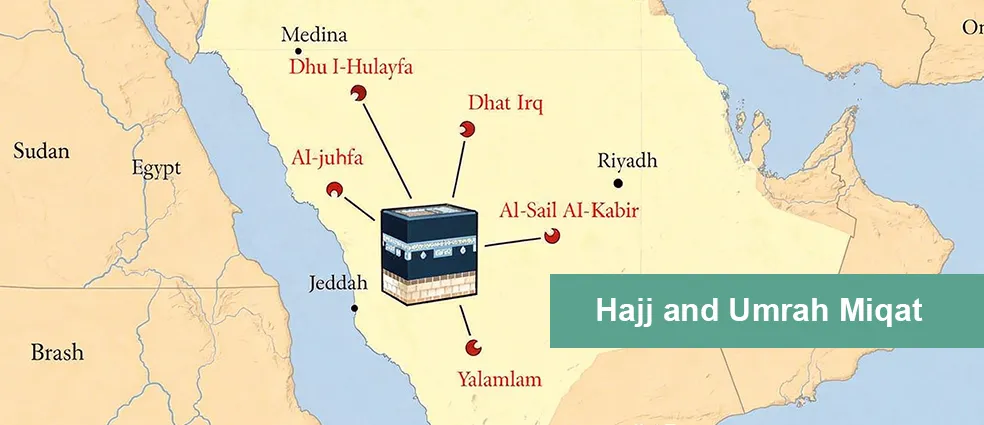
Miqat are the boundary points around Makkah where pilgrims must enter Ihram. Different routes have different points like Dhul-Hulaifa (from Madinah), Juhfa (from Syria), Qarn al-Manazil (from Najd), Yalamlam (from Yemen), and Dhat Irq (from Iraq). If a pilgrim does not pass directly through a Miqat, they must enter Ihram at a place that is parallel to it, otherwise a penalty (Dum) is required.
Pilgrims traveling by air should enter Ihram before boarding the plane or within 1–1.5 hours after takeoff so they do not cross the Miqat without being in Ihram. Upon first seeing the Kaaba, they should say “Allahu Akbar” three times and make sincere prayers. Instead of the usual two rak’ahs when entering the mosque, performing Tawaf is sufficient.
A pilgrim should enter Masjid al-Haram with Wudhu, stop reciting Labbayk, and men should uncover the right shoulder and wrap the Ihram over their left shoulder (Idhtibaa’).
They make intention for Tawaf, start at the Hajra e Aswad (Black Stone) with Istilaam (touch or point towards it, and kiss their palms) and complete seven rounds, men walk fast (Ramal) in the first three and normal in the last four.
They must recite duas, avoid turning their back to the Ka’bah, and do Istilaam at each round.
After finishing, they pray 2 rak’ahs, drink Zamzam and recite: “Allahumma inni as’aluka ‘ilman nafi’an, wa rizqan wasi’an, wa shifā’an min kulli dā’.”, and may make dua at Multazim.
For Sa’ee, they do one more Istilaam and go to Safa. They face the Ka’bah and make intention:
“O Allah, I intend to perform Sa’ee between Safa and Marwah—seven circuits for Umrah. Make it easy for me and accept it.”
They raise hands, say “Allahu Akbar”, and make dua.
They walk seven times between Safa and Marwah. Men jog lightly between the green lights. At each hill, they face the Ka’bah, raise hands again, and make dua. After completing at Marwah, they may pray 2 rak’ahs anywhere.
To exit Ihram, men shave the head (Halq) or trim hair (Qasr). Women cut about 1–2 cm from the end of their hair. After this, all Ihram restrictions end.
Yes, an umbrella can be used in Ihram because it is held above the head and not worn like clothing. However, men should not use umbrella-caps that are worn like a hat with elastic, but women may use them. Wearing sunglasses or prescription glasses is allowed because they do not cover the face.
These things do not affect the rule of not covering the face in Ihram.
If someone in Ihram wears a face mask because of a government rule or some necessity, they are not sinful.
However, if the mask is worn for one full day or one full night or more, then a Dum (sacrifice) becomes compulsory. If it is worn for less than one day or one night, then Sadaqah is required. If the mask is worn for less than one hour, then giving a handful of wheat or its price in charity is enough.
. Yes.
In Muzdalifah, pilgrims spend part of the night praying, making dua, collecting pebbles, and resting. Using an inflatable mattress is allowed if sleeping on the chattai(mat) is uncomfortable. It is permissible as long as it does not harm or inconvenience others and does not become a burden for you or others.
Current rules only allow pilgrims in Ihram, who intend to perform Umrah into the Mataf: it is not permissible to wear the Ihram only to enter the Mataf.
The rule is made to allow new pilgrims to be able to enter the Mataf and the ones who do not intend to perform Umrah or Sayee after the Tawaf are suggested to use other pathways created for them, such as the upper floors
The Ihram for men is an unstitched cloth; women can wear stitched clothes.
Women must keep their face uncovered but cover their head with a scarf; men’s head and face are not covered by the Ihram cloth.
Men wear sandals; women can wear any type of shoes.
Men recite Talbiyah loudly; women recite it softly.
Current rules only allow pilgrims in Ihram, who intend to perform Umrah into the Mataf: it is not permissible to wear the Ihram only to enter the Mataf.
The rule is made to allow new pilgrims to be able to enter the Mataf and the ones who do not intend to perform Umrah or Sayee after the Tawaf are suggested to use other pathways created for them, such as the upper floors
When you reach Riyadh and your journey from Riyadh to Jeddah begins, you will enter ihram during this journey. When the Miqat comes from Riyadh to Jeddah, the name of the Miqat is Qarn al-Manazil and it is the same Miqat that is for those who come from Najd and also for those who come from Ta’if. If you are passing through the Miqat, then you should intend to enter Ihraam. But it is advised this with caution that one may not be aware of the arrival of Miqat or might accidently miss it, therefore, when the journey to Jeddah has begun, it is suggested to enter Ihraam at the beginning of this journey and to make the intention of Ihraam. Hence, when you leave Riyadh, you should put on the sheets of ihram at Riyad Airport, and when you board the plane and the plane departs, you should intend to enter ihram and recite the Talbiyah. Allah has given us the opportunity today to witness the atmosphere with the sound of the Talbiyah even in the air. The far the Talbiyah reaches, it shall be testified on the day of Judgement.
One is the sacrifice of Hajj, which is done in Hajj-e-Tamato or Hajj-e-Qiran in the limits of the Haram. Apart from that, there is another sacrifice that is done on the occasion of Eid-ul-Adha. This sacrifice is obligatory on the ones who fall into the Nisaab. And on the days of Eid-ul-Adha, when there are days of sacrifice, if someone is on a journey in those days, then this sacrifice is not obligatory on the traveler. Yes, if a traveler is on a journey and decides to stay for 15 or more days, then the sacrifice is obligatory on the traveller.
Therefore, pilgrims do not stay at one place during Hajj for 15 or more days and thus the sacrifice is not obligatory for them but if someone is on a journey and wants to sacrifice, then he can do so. Although it is not obligatory, it can be done voluntarily.
The rule prohibiting the cutting of hair and nails for those making a sacrifice (Qurbani) is a secondary recommendation (Sunnah) and does not apply to Hajj or Umrah pilgrims. For pilgrims, cutting the hair or nails is a mandatory step to exit the state of Iḥrām after completing their rituals. Therefore, a pilgrim who is also offering a sacrifice must prioritize the mandatory Hajj/Umrah rule and cut their hair or nails to complete their rites of passage.
The term Ḥill refers to the area surrounding the Haram (Sanctuary) of Mecca, lying outside the Ḥudūd-e-Ḥaram (the defined boundaries of the Sacred Sanctuary). Examples of places in the Ḥill include Masjid Aisha (Tan’eem), Ji’rānah, and the plains of Arafat (Muzdalifah, however, is inside the Ḥudūd-e-Ḥaram).
For a person who is already residing in Mecca and wants to perform a subsequent Umrah, they must enter the state of Iḥrām from this area of the Ḥill; they are permitted to travel to any location just outside the Ḥudūd-e-Ḥaram—such as Masjid Aisha or Ji’rānah—to tie their Iḥrām before returning to Mecca to perform the Umrah rituals.
Yes, you are permitted to use fragrance-free sunscreen and other necessary personal care items like toothpaste, soap, Vaseline, and cream while in the state of Iḥrām, provided they contain absolutely no scent or perfume. You should thoroughly check all ingredients to ensure they are completely odorless, and it is also advisable to check the products of any companions to avoid inadvertently coming into contact with prohibited fragrances.
While in the state of Iḥrām, you must avoid touching scented items, including the coverings of the Kaaba, the Hajar al-Aswad (Black Stone), and the Multazam, like so that you transfer the scent onto yourself, as getting perfume on your body or clothes necessitates a penalty (Dum). (That’s why during the hajj days they lift the coverings of the Kaaba higher so you do not touch it and ends up with dum.)
Furthermore, you must be extremely careful when interacting with companions who have already exited Iḥrām, as their clothes or hands may carry strong fragrances that could transfer to your Iḥrām garments, which also incurs a penalty. Those who have finished their Umrah should be mindful not to use fragrances that could affect their companions still observing the Iḥrām restrictions.
Upon your flight from Malaysia to Jeddah, you must enter the state of Iḥrām (make the intention and put on the garments) before the plane crosses the Miqat boundary (specifically, the Miqat of Yalamlam), which occurs approximately one hour before landing in Jeddah. You cannot delay Iḥrām until after arriving at Jeddah and resting in Aziziyah, because Aziziyah is considered part of Mecca City and falls inside the Miqat boundary. The correct procedure is to put on the Iḥrām garments in Malaysia and then make the Niyyah (intention) just before crossing the Miqat in the air. Once in Iḥrām, you are permitted to proceed to Aziziyah to rest for several hours or even overnight before traveling to the Haram to perform your Umrah, as the rules of Iḥrām do not mandate immediate performance of the rituals.
after the initial one is completed.
Answer29. Yes, your previous action was correct: when you first travel to Mecca for Umrah, you must enter Iḥrām at the designated Miqat before Jeddah (like Yalamlam). However, once you have arrived in Mecca, performed that initial Umrah, and are residing there, you are then considered a resident of Mecca (or within the boundaries). If you wish to perform a subsequent Umrah, you are not required to return to the distant Miqat; instead, you can enter Iḥrām from any point just outside the Ḥudūd-e-Ḥaram (the Sacred Sanctuary boundaries), such as Masjid Aisha (Tan’eem), Ji’rānah, or Gudabiyyah. This rule applies to those already residing inside the Haram area who wish to perform additional Umrahs.
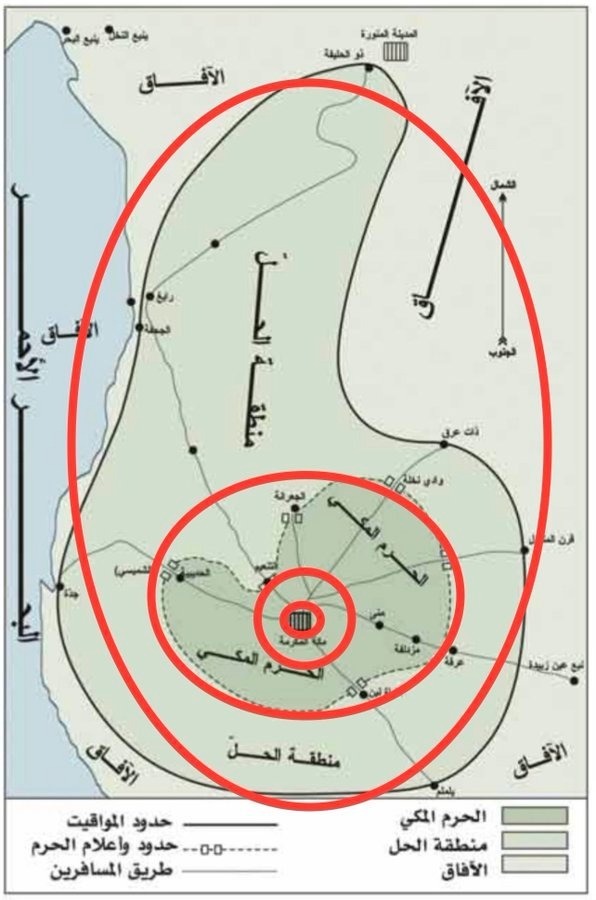
This map may help you to understand Miqat, Hil, Haram, Mecca city and Masjid al Haram.
The biggest area is this area of Miqat. It contains numerous Miqats such as Zulhul-Hulaifa, Yalam-Lam, Qarn al-Manazil and Zat-ul-Irq. It is the largest area in the area. It is 400 km on one side, and it is a bit short on the other side, and it is more on the other side.
The farthest Miqat is Madina Manowra which is called Zulhul-Hulaifa. The closest Miqat is Taif. Outside this area is Afaaq, and the residents there are called Afaaqi. And this area inside is called Hil, and the people living here are called residents of Hil. Hil means that this place is not like a Haram where they can hunt, cut trees or break leaves, etc. And after that, the second area is Hudoode-e-Haram. There are places like Masjid Aisha or Masjid Jairana or like Hudaibiyyah. Inside this area, there is a Haram, and outside it is called Hil. Inside this area, there are rules of Haram where you cannot hunt, trees cannot be broken, grass cannot be cut, etc., as mentioned in the Hadith.
The third area is Makkah City. Inside this third area, there is almost Makkah Mukarrama city, and outside it has other areas like Mina and Mujdalifah, etc. So, all of these are included in the Haram. So, Makkah is also included in the Haram, and outside Makkah city, the other areas are part of the Haram like Mina and Mujdalifah are also part of the Haram. The smallest area is Masjid-e-Haram. Hopefully this will help a lot to understand it.
. Yes, after completing the core rituals of Umrah (Ṭawāf and Sa’y) or the relevant rituals in Mina during Hajj (like Rami and sacrifice), those who have completed their necessary steps can safely cut their own hair or the hair of another pilgrim. The key condition is that both individuals must have completed all rituals preceding the hair cutting stage; for example, a person who has only completed Ṭawāf but not Sa’y cannot cut their own hair or assist another. While mutual assistance is permissible, one should be cautious when shaving another person’s head with a sharp razor, especially if they are inexperienced, to ensure the ritual is performed properly and safely.
For the removal of Iḥrām restrictions (Taḥallul) after Umrah or Hajj, you must either shave your entire head or trim the hair. The most complete way to trim is to cut the entire head of hair to a length of about one inch. According to some scholars (Fuqahā’), it is minimally permissible to trim at least one-fourth of the head’s hair by one inch. If, however, you do not have enough hair to meet this one-inch minimum across one-fourth of your scalp (either due to natural thinness or previous trimming during Umrah), then you must shave the head completely; simply trimming is insufficient in this case.
Since your total travel plan—from arriving in Jeddah on the 30th, moving through Mecca and the Hajj sites, and then traveling to Madinah for your departure on the 14th—does not involve staying in any single city for a full fifteen days, you will be considered a traveler (Musāfir) throughout your entire journey. As a traveler, you must shorten the four-unit prayers (Dhuhr, Asr, and Isha) to two units (Qaṣr), unless you are praying behind a resident Imam, in which case you must complete the full prayer. While other Sunnah prayers become optional (Nawāfil), it is strongly advised to maintain the two Sunnah Rak’āt of Fajr. Because this is a journey of worship where rewards are multiplied, you should also take every opportunity to perform Nawāfil (voluntary prayers), Dhikr, and other optional acts of worship.
The sheets of Iḥrām are merely a symbol; they can be removed, changed, and washed whenever necessary, and it is wise to carry an extra set. The essence of Iḥrām is not the cloth itself, but the commitment to observe the corresponding prohibitions, such as avoiding perfume, refraining from cutting hair or nails, and men not wearing stitched clothing or covering their heads. For example, women who tie a cloth around their head should understand that opening it to perform Masḥ (wiping over the hair during Wuḍū’) does not invalidate their Iḥrām, as the restrictions relate to specific actions, not the continuous wearing of a specific garment.
.While in the state of Iḥrām, using any product that contains scent, including toothpaste, soap, or liquid cleansers, is prohibited. It is essential to exercise caution and actively seek out truly fragrance-free versions of these items, which are commonly available at Hajj supply shops and specialized stores catering to pilgrims. It is suggested to do some hard work and find for such things.
However, the use of Miswaq is permissible, even if it leaves a taste behind, there is no harm in using it
Since your stay for Hajj is a short package (14 to 17 days), you will be considered a traveler (Musāfir), and the annual Eid al-Aḍḥā sacrifice (Uḍḥiyah) is not obligatory for a traveler. You are only obliged to perform the sacrifice required for Hajj (Hady). However, if you wish to maintain your usual practice and offer an extra sacrifice back home or even perform the Uḍḥiyah in Mina alongside your Hady, you are certainly permitted to do so; it is not prohibited, and many choose to maintain the tradition even when the obligation is lifted due to travel.
While in Iḥrām, there is no prohibition against cleaning the body, removing dirt and sweat, or using soap; the only restriction related to cleansing is that the products must be unscented. Although some narrations suggest Allah favors the “disheveled” state of the pilgrim, this refers to humility (tawāḍu’) and lack of excessive focus on worldly appearance and clothing, not mandatory physical uncleanliness, similar to how a fasting person is encouraged to continue their personal hygiene (like using miswāk) but the smell of his mouth is loved by Allah. It does not mean the pilgrim should intentionally remain physically dirty. Furthermore, wiping sweat from the face or drying the head with a towel or tissue is permissible, as long as the act does not involve fully covering the face or head (which is prohibited for men).
. During Hajj, various missteps require compensation, categorized as either a Dum (a specific sacrifice, which is essentially a form of Ṣadaqah/charity) or a lesser Ṣadaqah. If you commit an act requiring a Dum, the resulting sacrifice is used to compensate for the deficiency in your worship, and the obligation remains even after Hajj is over.
However, unlike the time-bound Eid al-Aḍḥā sacrifice, the Dum does not need to be offered during the specific days of Dhu al-Hijjah, but it must be offered and distributed to the poor within the boundaries of the Ḥaram (Mecca and its precincts, like Mina), not at your home or another location.
There are two distinct types of sacrifice: the Hajj sacrifice (Hady), which becomes mandatory for pilgrims performing Hajj al-Tamattu’ or Hajj al-Qiran as an act of gratitude for combining Umrah and Hajj, and the annual Eid al-Aḍḥā sacrifice (Uḍḥiyah). The crucial difference is in the location: the Hajj sacrifice (Hady) must be performed strictly within the Ḥudūd-e-Ḥaram (Mecca and its surrounding areas like Mina and Qa’qia), and cannot be done elsewhere (like Jeddah or Pakistan). In contrast, the Uḍḥiyah (which may be obligatory or voluntary) can be performed anywhere, including at home or within the Ḥudūd-e-Ḥaram.
The rule of Iḥrām prohibits men from wearing stitched or tailored clothing; however, if an elderly man struggles with urine leakage, he has two options. He should first attempt to manage the issue using unstitched cloth tied around the lower body to catch the discharge while ensuring purification (ṭahārah). If this is extremely difficult or impractical, then due to this necessity (ḍarūrah), he is permitted to use discreet, sealed, absorbent garments (like pads or adult diapers). If he relies on such a tailored garment for twelve hours or more during Iḥrām, he will be required to offer a Dum (a compensatory sacrifice) as a penalty for covering the violation caused by necessity. However, he may not be sinned for doing so due his helplessness. Rest Allah knows best.
The pillars of the pilgrimage rituals are categorized into Fardh (Obligatory) and Wajib (Required) acts.
For Hajj, the three Fardh acts are Iḥrām, the Wuqūf in ʿArafah (Standing at ʿArafah), and Ṭawāf al-Ziyārah (the main Hajj Ṭawāf).
The Wajib acts include the Wuqūf in Muzdalifah, Saʿī between Safā and Marwah, Ramī al-Jamārāt (Stoning), Ḥalq or Qaṣr (Shaving/Trimming), and Ṭawāf al-Wadāʿ (Farewell Ṭawāf, for non-residents). Notably, Sacrifice (Qurbānī) is also a Wajib act, but only for those performing Hajj al-Tamattuʿ or Hajj al-Qirān.
For Umrah, the Fardh acts are Iḥrām and Ṭawāf around the Ka’bah, while the Wajib acts are Saʿī between Safā and Marwah and Ḥalq or Qaṣr. (Note: Umrah is a Sunnah act that can be performed year-round, but it is disliked (Makrūh) during the main days of Hajj, from the 8th to the 13th of Dhul-Hijjah).
The Ṭawāf begins at the corner of the Kaaba where the Hajar al-Aswad (Black Stone) is located. The starting line is marked by a green tube light on the wall or floor of the Masjid al-Haram, which helps pilgrims gauge the exact point parallel to the Hajar al-Aswad. To begin, you must face the Hajar al-Aswad to acknowledge it (by kissing it or pointing to it), and then immediately turn so that the Kaaba is on your left shoulder. It is essential to keep the Kaaba to your left throughout the circuit; if your face or chest turns to face the Kaaba while walking, that portion of the circuit will not count.
It is most practical and recommended for pilgrims already residing in Mecca (like in Aziziyah) to enter the state of Iḥrām for Hajj at their accommodation before departing for Mina. Although some sources mention entering Iḥrām from the Masjid al-Haram, this is highly impractical on the days leading up to Hajj (7th/8th Dhu al-Hijjah) due to extreme traffic congestion and road closures. Attempting to reach the Haram and perform optional prayers before entering Iḥrām risks significant delays (potentially 6+ hours), causing inconvenience for your group and potentially missing your scheduled transport to Mina. Since you are already considered a resident of Mecca, binding your Iḥrām from your current lodging is fully permissible and prevents unnecessary logistical risk.
When a pilgrim performs Umrah, the final step to be released from the prohibitions of Iḥrām is to cut or shave the hair (Taḥallul). This act is mandatory, and until the hair is cut, the pilgrim remains bound by all Iḥrām restrictions.
This rule applies equally to both men and women performing Umrah or Hajj. Therefore, while generally speaking, one does not need to cut their hair at other times during the pilgrimage, it becomes necessary under specific circumstances to achieve freedom from Iḥrām after completing the rites.
For Ṭawāf (circumambulation), having Wuḍū’ is mandatory. If your Wuḍū’ breaks, you must stop, renew your ablution, and then resume your Ṭawāf from the round where you left off, however it is suggested that you start from Hajra-e-Aswad and continue your count.
In contrast, having Wuḍū’ is not mandatory for performing Sa’y (the walk between Safa and Marwah). If you need to use the restroom or renew your ablution during Sa’y, you may simply return and continue the Sa’y from the exact place you stopped, or pick up the count at Safa or Marwah, although it is recommended to renew your Wuḍū’ before continuing.
The entire area of Mecca, including neighborhoods like Aziziyah, falls within the Ḥudūd-e-Ḥaram (the Sacred Sanctuary), not just the Masjid al-Haram and the immediate surrounding hotels. This is important because the mandatory Hajj sacrifice (Hady), hair trimming and any compensatory penalty sacrifice (Dum) must be offered and slaughtered strictly within this greater Ḥaram boundary (such as in Mina or the designated slaughterhouses), and cannot be performed outside the sacred limits.
The sacrifice offered during Hajj is known as Dum al-Shukr (the sacrifice of gratitude). Its purpose is to show thanks to Allah Almighty for enabling the pilgrim to combine Umrah and Hajj into a single journey. This sacrifice is obligatory (wājib) only for those performing Hajj al-Tamattu’ (Umrah followed by Hajj) or Hajj al-Qiran (combining the intention for Umrah and Hajj). If a pilgrim performs Hajj al-Ifrād (Hajj only, without Umrah), this particular sacrifice is not required.
There is a distinction in the rules regarding consuming the meat from different types of sacrifices: the Dum al-Shukr (the sacrifice of gratitude required for Hajj al-Tamattu’ or Qiran) is one that the pilgrim is allowed to eat from.
However, any Dum required as a penalty for violating a prohibition of Iḥrām or any act of penalty is a form of compulsory charity, and the pilgrim who incurred the penalty cannot consume that meat; it must be entirely distributed to the poor and needy.
The prohibitions of Iḥrām, such as the ban on perfume, cutting hair, and cutting nails, are tied to the state of Iḥrām itself, regardless of whether it is for Hajj or Umrah, and are not bound to a specific date or time. These major restrictions cease only after the pilgrim performs the necessary act of shaving or trimming the hair (Taḥallul). Once Taḥallul is performed (e.g., after Sa’y for Umrah, or after Rami and sacrifice for Hajj), the pilgrim is free to use perfume for subsequent rites like Ṭawāf al-Ziyārah. However, extreme caution is necessary when interacting with companions who have already exited Iḥrām and applied scent, as transferring any fragrance to a person who is still under Iḥrām restrictions (or is wearing a new Iḥrām) can cause them to incur a penalty.
The Sunnah is to perform Ṭawāf al-Wadā as the final act of worship before departing from Mecca, after all Hajj rites (Manāsik)—including Rami—are fully completed. It is not permissible to combine the intention for Ṭawāf al-Wadā with the mandatory Ṭawāf al-Ziyārah, just as one cannot combine a Nafl (voluntary) prayer with a Farḍ (obligatory) prayer. While an exception is allowed for extreme compulsion (ḍarūrah), such as an imminent flight departure after Ziyārah, for pilgrims with time available, rushing the Farewell Ṭawāf before all other rituals are finished is contrary to the Sunnah.
The Prophet Muhammad (PBUH) explicitly forbade offering Nafl prayers during two specific periods: after the Fajr prayer until the sunrise is complete, and after the Asr prayer until the sunset. This prohibition applies universally to all places, including the Masjid an-Nabawi and its distinguished section, Riyad ul-Jannah. The idea that these sacred areas are exempt from the ruling is incorrect, as the Prophet (PBUH) most likely issued these instructions while present in Masjid an-Nabawi itself. Therefore, during these forbidden times, pilgrims should focus on other acts of worship that are permissible, such as Dhikr (remembrance), Tasbīḥ (glorification), and recitation of the Qur’an.
Since you are on a short package, you will be considered a traveler (Musāfir) throughout your Hajj journey. As a traveler: 1) You must pray the full prayer if you follow a local resident Imam. 2) If you pray alone or behind another traveler, you must observe Qaṣr (shortening) for the Dhuhr, Asr, and Isha prayers (two units instead of four). Fajr (two units), Maghrib (three units), and Witr (three units) are prayed fully. Regarding Sunnah prayers, they become voluntary (Nawāfil) during travel, except for the two Sunnah units of Fajr, which are highly emphasized and should not be omitted. Given that this is a journey of worship, you are encouraged to utilize any free time to perform optional prayers and other acts of worship rather than neglecting them.
Since you intend to perform Hajj al-Qirān, you must make the intention (niyyah) for both Umrah and Hajj together when you enter Iḥrām, you must ensure your Iḥrām is correctly initiated for both simultaneously and must remain cautious as any error could result in two separate penalties (Dum). As your state of Iḥrām will be long, you must strictly observe all prohibitions.
Regarding your rest: It is permissible for both men and women to use blankets or sheets to cover their bodies for warmth while in Iḥrām. However, men must be careful not to cover their heads, although they may cover their feet with the blanket (since the prohibition is only on wearing stitched footwear). Conversely, women must cover their heads but are prohibited from covering their faces with any fabric touching the skin.
It is permissible and rewarding to perform additional, voluntary Umrahs (Nafl Umrah) on behalf of deceased relatives (parents, ancestors) or even on behalf of the Prophet Muhammad (PBUH), provided you have sufficient time and ease to do so. The underlying principle is that you first perform the Nafl Umrah for yourself, and then you may dedicate the reward (thawāb) to anyone you wish by making a sincere prayer (Du’a) to Allah. You can perform multiple Umrahs, one for each person, or you may perform a single Nafl Umrah and dedicate the reward to multiple individuals simultaneously, as Allah’s bounty is limitless. There is no specific order regarding which deceased person should receive the reward first.
Before embarking on the Hajj journey, it is essential to seek forgiveness from anyone you may have wronged regarding their rights (ḥuqūq) and try to reconcile any personal offenses. This effort to resolve grievances makes the Hajj forgiveness more complete and perfect. Even if certain relatives or friends are difficult to deal with, you must maintain at least a minimal level of connection—such as exchanging greetings—to avoid the sin of completely severing ties (qaṭ’ al-raḥm).
The Prophet Muhammad (PBUH) clarified that the true one who maintains kinship is not the one who only reciprocates kindness, but the one who continues to show kindness even when the other party severs the relationship. Therefore, pilgrims should purify their hearts of enmity before Hajj, considering this emotional effort part of the comprehensive obedience and sacrifice required for the pilgrimage.
The two major forms of combined pilgrimage are distinguished by the pilgrim’s intention and continuous state of Iḥrām. The method of entering Iḥrām at the Miqat, completing Umrah, exiting Iḥrām (by cutting hair), and then later entering Iḥrām again for Hajj is called Hajj al Tamattu’. If you perform Umrah then you may exit Ihram but then you can not intend for Hajj al Qiran.
In contrast, Hajj al Qirān can only be achieved by combining the intention for both Umrah and Hajj simultaneously when first entering Iḥrām at the Miqat, and then maintaining that single state of Iḥrām and its restrictions continuously apply until the Hajj rituals are finished. The ruling regarding combining these acts does not apply to permanent residents of Mecca (those “near Masjid al-Haram”) instead it is only for those who comes from away (Afaqi).
If your Ṭawāf ends during a period when performing Nafl (voluntary) prayers is forbidden—specifically, immediately after Fajr until sunrise, after Asr until sunset, or at midday (when the sun is at its zenith)—you must wait for that discouraged time (Makrūh Waqt) to pass. It is not permissible to offer the two mandatory units of prayer after Ṭawāf (Wājib al-Ṭawāf) during these times. You should wait for the permissible time to begin and then offer the prayer.
The total number of times one performs Istilām (acknowledging the Black Stone) during Ṭawāf depends on whether the Ṭawāf is followed by Sa’y. Every circuit begins with Istilām (including the very first one), meaning there will be eight Istilām acts during the seven circuits of the Ṭawāf. If you perform Sa’y immediately after the Ṭawāf (as is done during Umrah or Hajj al-Qudūm), you must perform one final Istilām before heading toward the Safa hill, bringing the total number of Istilām acts to nine.
When offering the two voluntary units of prayer (Nafl) before making the formal intention (Niyyah) for Iḥrām, it is advisable for men to keep their heads uncovered. Although the prohibition against covering the head only begins after making the intention and reciting the Talbiyah, experience shows that pilgrims often forget to remove their cap or turban immediately after the prayer. If the head remains covered when they make the Iḥrām intention and recite the Talbiyah, they would instantly violate the Iḥrām restrictions. Therefore, to ensure the Iḥrām is begun correctly, it is safest to pray the Nafl with the head uncovered.
Yes. It is permissible to use scented soap during the ritual bath (ghusl) taken before entering the state of Iḥrām. The key is that the soap’s fragrance should be completely washed off during the bath and should not linger on the body or hair. Since the soap’s scent is removed by the water, it is not considered a violation of the Iḥrām restriction against applying perfume, and therefore, there is no harm in using it.
People travelling or amidst travelling should recite the following:
اللهُ أَكْبَر، اللهُ أَكْبَر، اللهُ أَكْبَر.
سُبْحَانَ الَّذِي سَخَّرَ لَنَا هَذَا وَمَا كُنَّا لَهُ مُقْرِنِينَ * وَإِنَّا إِلَى رَبِّنَا لَمُنْقَلِبُونَ.
اللَّهُمَّ إِنَّا نَسْأَلُكَ فِي سَفَرِنَا هَذَا الْبِرَّ وَالتَّقْوَى، وَمِنَ الْعَمَلِ مَا تَرْضَى.
اللَّهُمَّ هَوِّنْ عَلَيْنَا سَفَرَنَا هَذَا وَاطْوِ عَنَّا بُعْدَهُ.
اللَّهُمَّ أَنْتَ الصَّاحِبُ فِي السَّفَرِ وَالْخَلِيفَةُ فِي الْأَهْلِ.
اللَّهُمَّ إِنِّي أَعُوذُ بِكَ مِنْ وَعْثَاءِ السَّفَرِ وَكَآبَةِ الْمَنْظَرِ وَسُوءِ الْمُنْقَلَبِ فِي الْمَالِ وَالْأَهْلِ.
Transalation:
Allah is the Greatest, Allah is the Greatest, Allah is the Greatest.)
Glory is to Him Who has subjected this to us, and we were not capable of [doing] it * and indeed, to our Lord we will [eventually] return.
O Allah, we ask You for piety and consciousness of Allah in this journey of ours, and for the kind of deeds that please You.
O Allah, ease for us this journey of ours and make its distance short for us.
O Allah, You are the Companion in the journey and the Guardian of the family [left behind].
O Allah, I seek refuge in You from the difficulties of the journey, the sadness of the sight [of a bad happening], and the ill return with regard to my property and my family.
For pilgrims intending for Umrah, they recite the following,
اللَّهُمَّ إِنِّي أُرِيدُ الْعُمْرَةَ فَيَسِّرْهَا لِي وَتَقَبَّلْهَا مِنِّي
Followed by:
لَبَّيْكَ اللَّهُمَّ لَبَّيْكَ.
Transalation:
O Allah, I intend for Umrah. Make it easy for me and accept it from me.
And after that, recite the Talbiyah:
I respond to Your call, O Allah, I respond to Your call.
As for the pilgrim performing Hajj al-Tamattu’, they should make the intention for Umrah from the Miqat, wear the Iḥrām, and begin reciting the Talbiyah.
If you wish to perform a voluntary Umrah (Nafl Umrah) while staying in Mecca, you must first travel outside the boundary of the Sacred Sanctuary (Ḥudūd al-Ḥaram). You should take a taxi to a nearby designated Miqat, such as Masjid Aisha (Tan’eem) or Masjid al-Ji’ranah. At that location, you will make the intention for Umrah, offer two units of optional prayer (Nafl), and then enter Iḥrām before returning to Mecca to perform the Ṭawāf and Sa’y.
The answer is that residents of Mecca and the surrounding areas (like Jeddah) are generally instructed to perform Hajj al-Ifrād (Hajj only) because the obligation of sacrifice applies primarily to those combining Umrah and Hajj who are not residents (“whose family is not present around the Masjid al-Haram”).
Therefore, while the most appropriate type of Hajj for a Jeddah resident is Ifrād, they are strongly encouraged to offer a voluntary sacrifice (Hady) in addition to raising their voices in the Talbiyah (Al-‘Ajj) to ensure they fulfill the complete virtue of the best form of Hajj that includes both loud declaration and sacrifice (Al-Thajj).
. In fiqh terms, Jeddah is considered within the Hill area (residents of Miqat and Haram precincts).
Those living within the Miqat boundaries (like Jeddah) are generally instructed to perform Ifrad Hajj (Hajj alone without Umrah)
For Ifrad Hajj, sacrifice is not obligatory, unlike Qiran or Tamattu’ where it is required
There are two key distinctions regarding sacrifice: The mandatory Hajj Sacrifices (such as Dum al-Shukr required for Hajj al-Qirān or Hajj al-Tamattu’) must be performed strictly within the designated boundaries of the Ḥaram (Makkah and its immediate surrounding areas like Mina), and it is not permissible to arrange for this specific sacrifice outside this limit, such as in Pakistan.
The second is the annual Eid al-Aḍḥā Sacrifice (Qurbānī), which is generally not obligatory for Hajj pilgrims because the Hajj package typically involves a stay short enough for the pilgrim to remain classified as a traveler (musāfir), for whom the obligation of the Eid sacrifice is waived. However, if a traveler chooses to perform a voluntary Eid sacrifice, it is permissible to arrange for it to be done in their home country (like Pakistan) instead of Mecca.
The following actions, if performed during Hajj or Umrah while in the state of Iḥrām, necessitate a Dum (slaughter of one sheep or equivalent) or, in the severest case, invalidate the Hajj:
⦁ Applying perfume to a complete limb or more while in the state of Iḥrām.
⦁ Wearing stitched clothing for a full day or a full night while in the state of Iḥrām necessitates a Dum. If this continues for several consecutive days, only one Dum is required.
⦁ Removing one-fourth or more of the hair of the head or beard by any method necessitates a Dum.
⦁ The same ruling (Dum is required) applies to completely cleaning the hair of the entire neck, an entire armpit, or the entire pubic area.
⦁ Clipping all five fingernails or all five toenails on one hand or foot, or trimming twenty nails simultaneously.
⦁ Kissing or fondling one’s spouse with desire (shahwah), before Ṭawāf al-Ziyārah (the main Hajj Ṭawāf), necessitates a Dum.
⦁ Having sexual intercourse before the Wuqūf at ʿArafah (Standing at ʿArafah) invalidates the Hajj (fāsid). The pilgrim must complete the rituals like Hajj, offer a Dum, and make up the Hajj the following year (Qaḍāʾ).
⦁ Entering the boundaries of the Ḥaram without Iḥrām. However, if the pilgrim returns to the Miqat and enters Iḥrām from there, the Dum is waived.
⦁ Performing the whole or the majority of Ṭawāf al-Ziyārah without Wudū’ (ritual purity) necessitates a Dum. The Dum is waived if the pilgrim repeats the Ṭawāf with Wudū’.
⦁ Omitting the majority of Ṭawāf al-Qudūm (Arrival Ṭawāf) or Ṭawāf al-Wadāʿ (Farewell Ṭawāf), or omitting the Farewell Ṭawāf entirely, necessitates a Dum. (Note: The Farewell Ṭawāf is waived for a menstruating woman.)
⦁ Departing from ʿArafāt before sunset. However, if the pilgrim returns before sunset and only leaves after sunset, the Dum is waived.
⦁ Failing to perform the Wuqūf (stay) in Muzdalifah on the morning of the 10th of Dhū al-Ḥijjah without a valid excuse.
⦁ Failing to throw any pebbles on any day, or omitting all or most of the pebbles for a single day.
⦁ Performing the shaving/trimming of the hair (Ḥalq) outside the boundaries of the Ḥaram.
⦁ Delaying the shaving/trimming of the hair to the extent that the days of sacrifice (10th to 12th of Dhū al-Ḥijjah) have passed.
⦁ Delaying Ṭawāf al-Ziyārah without a valid excuse.
When traveled from Madinah Munawwarah toward Makkah Mukarramah it is required to make the intention for Ihram and enter Ihram at the Miqat. If they passed the Miqat without making the intention or entering Ihram and then reached Makkah, there are two permissible solutions.
One option is to enter Ihram from their current location, perform Umrah, and give Dum as a penalty from each person who is financially able.
The second option is to return to a Miqat—whether the Miqat on the side of Madinah Munawwarah, the Miqat on the side of Ta’if—enter Ihram from there, and then perform Umrah, in which case no donation (Dum) is required.
It should be noted that Ihram begins only when one makes the intention and recites the Talbiyah; if Talbiyah was recited with the intention of Ihram, then Ihram has begun, and if it was not recited with such intention, then Ihram has not commenced.
With over two decades of expertise, we are proud to be the ideal choice for pilgrims seeking a trustworthy Hajj Partner.

Hajj services refer to the various facilities and support provided to Muslim pilgrims who undertake the Hajj pilgrimage to the holy city of Mecca, Saudi Arabia. Hajj is one of the Five Pillars of Islam and is obligatory for all physically and financially able Muslims to perform at least once in their lifetime.